
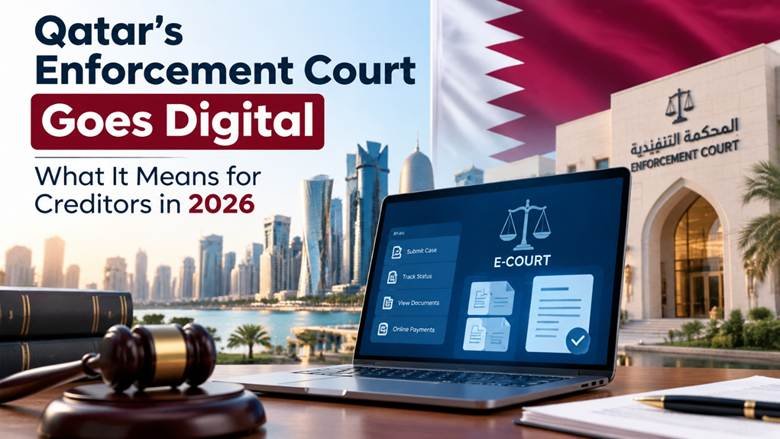
Winning a case has never been the hard part. Collecting afterwards is where creditors lose patience — chasing an execution file, waiting on paperwork, sending someone to a counter in Doha to ask what stage things have reached.
That picture has been changing. Qatar restructured enforcement under the Judicial Enforcement Law (Law No. 4 of 2024), which created a dedicated Enforcement Court in place of the enforcement department that previously sat within the civil procedure framework. In April 2026, the Supreme Judicial Council went further, issuing Decision No. 9 of 2026 on electronic judicial procedures.
For anyone using debt recovery services in Qatar, these are practical changes, not administrative housekeeping.
What the New Enforcement Court Changed
The 2024 law did more than rename a department. It gave enforcement its own court, with clarified authority over requests to enforce a writ of execution, objections raised against enforcement, and appeals against an enforcement order.
It also addressed enforcement of an arbitration award, the court’s powers to recover debt, and the judge’s ability to order attachment over a judgment debtor’s property. And it introduced sanctions where a debtor or third party obstructs enforcement, conceals assets, or refuses to hand over property belonging to the debtor — a meaningful shift in leverage for a judgment creditor.
What the 2026 Digital Rules Add
Decision No. 9 of 2026 recognises the enforceability of the electronic signature and confirms that virtual verification of parties is valid at every stage of proceedings. The Ministry of Justice has separately introduced a system for electronic execution of documents.
Combined with the court’s existing Ministry of Justice portal, e-filing and remote hearing facilities, this means a creditor’s representative can progress matters that previously required physical attendance.
Why This Matters Commercially
Less waiting on logistics. Steps that once depended on someone being physically present can now move without that delay.
Easier for creditors outside Qatar. A foreign judgment creditor, or a company headquartered elsewhere in the GCC, can be represented and verified remotely rather than flying in.
Clearer procedure. The 2024 law sets out objection and appeal routes more explicitly than the previous framework, which makes it easier to anticipate how a debtor may respond.
What Has Not Changed
Digital filing does not make a weak claim strong. You still need the correct debtor entity, reconciled figures and a properly documented judgment.
Nor does technology locate money. Enforcement still depends on asset disclosure and on what the debtor actually holds — a debtor with nothing in Qatar remains difficult regardless of how efficiently the file moves.
And speed at the court does not undo delay at your end. A claim left for two years before anyone acted is still a two-year-old claim.
Choosing a Debt Recovery Company in Qatar
When comparing a debt recovery company in Qatar, ask how they are using these changes. Do they file electronically? Can they handle judgment enforcement Qatar matters without requiring you to attend? How do they trace assets before filing?
LawBridge Qatar is licensed by the Ministry of Justice and takes matters from first notice through enforcement court Qatar proceedings. Assessments are free, with advice in English, Arabic, Hindi, Nepali, Malayalam, Tamil and Sinhala.
📞 +974 7786 5050 · ✉️ admin@lawbridgeqatar.com
Frequently Asked Questions
Does Qatar have a digital enforcement court?
Qatar has an Enforcement Court, created by the Judicial Enforcement Law of 2024, and a growing set of electronic procedures around it — including rules issued in 2026 recognising electronic signatures and virtual verification. It is a conventional court operating with digital procedures, not a separate online court.
Can I enforce a judgment in Qatar without being there?
Increasingly, yes. Virtual verification and electronic procedures reduce the need for physical attendance, and a notarised power of attorney allows your lawyer to act throughout.
What powers does the Enforcement Court have?
Its authority covers enforcement of a writ of execution, related objections and appeals, enforcement of arbitration awards, and orders including attachment of a debtor’s property. It can also apply sanctions where enforcement is obstructed.
Does this apply to foreign judgments?
Foreign judgments go through a recognition process before enforcement, with conditions attached. Ask a lawyer to assess your specific judgment.
Has enforcement become faster?
Procedural steps have become less dependent on physical attendance, which removes some delay. Actual recovery still depends on locating assets and on how the debtor responds.
SEO Title Qatar’s Enforcement Court Goes Digital: 2026 Update
Meta Description Qatar’s new Enforcement Court and 2026 digital hearing rules — what they change for creditors chasing judgments.
URL Slug qatar-enforcement-court-digital
Focus Keyphrase (Yoast) enforcement court qatar
Primary Keyword debt recovery services in Qatar
Secondary Keywords debt recovery company in Qatar · enforcement court Qatar · judgment enforcement Qatar
Image File Name qatar-enforcement-court-digital.jpg
Image Alt Text Qatar Enforcement Court digitisation — debt recovery services in Qatar 2026
Tags enforcement court qatar · judgment enforcement qatar · debt recovery qatar · judicial enforcement law · legal services qatar